If there's one question that I consistently get from friends and online acquaintances, it is one for advice on writing a book. It seems that everyone wants to write a book. People write books for different reasons. I think I was born wanting to write a book, I majored in English Literature for that reason. For other reasons, I ended up in marketing, but the need to write a book - to help people - never went away. The most common reasons I hear from people are:
Establish themselves as an expert in their field (does that really work?)
Get more speaking engagements
Satisfy a heartfelt need
Fulfill their ego to be a "published" author
Writing and selling my books is my main job (along with constantly researching my topics), it comes before everything else, even social media and speaking. I have been writing books since 1998 and sold a million by 2007. I don't count the numbers anymore, what counts to me is hearing from my readers. I am lucky to have been writing long enough to see the impact my books have made on my reader's lives.
Wanting to write a book and actually finishing the project are two vastly different things - just ask anyone who has written one. You also need to know, writing books are not for everyone. "Long form" content takes on a completely new meaning when you're expected to write not just 1,500 words - but over 300 pages on a topic.
After I graduated and got in the real world of advertising, my observances of the small business people taught me far more than a classroom ever could. There were those (no matter how great their customer service) who just couldn't make a go of it. Others succeeded in ways which were a mystery to me. Dumb luck, I guess.
But for those who achieved some modicum of success, they found their niche and were able to grow. Their business built jobs for family and others. Some expanded their enterprise to other locations and many, eventually online.
These people took a challenge and grabbed it. They worked out what they knew and studied to learn more of what they didn't. It takes a special kind of entrepreneur to succeed and build a business for a lifetime. It really made no difference whether they chose to stay small or to expand. Their accomplishment spoke volumes.
Now that anyone with a plan and some gumption has access to an international marketplace on the Internet, it brings new challenges. I would have never thought that my small, online business would be shipping product to Moscow, or Buenos Aires or Tokyo. But I have; and now service customers worldwide.
Which brings me to the point of this post. The idea of sending merchandise to customers overseas used to scare the heck out of me. I knew there were customs regulations and I knew it would be ever more expensive (even if the customer paid the shipping). Who would even care to spend extra to buy from me?
I took the step first by selling action figures and opened up sales to a worldwide audience. Amazingly, even in the early 2000s, there were people willing to buy and pay a premium for my goods!
The first step is getting past that fear. When businesses are growing and succeeding, there always seems to be a similar barrier: expanding globally. I’ve worked with more business owners than I can count who just don’t want to go the extra mile (pun intended) and expand their markets internationally.
There are various reasons entrepreneurs hesitate before taking the global leap. For one, there’s a popular myth that shipping across borders significantly changes the status quo. Yes, no one likes change, but the logistics behind international shipping can be just as easy to navigate as domestic shipments once you know the rules.
An easy way to get your feet wet is to take a single product and start selling on an established international marketplace like eBay. For any ecommerce business, I suggest starting slowly and first deciding which products and countries blend best for your business. Read my article here for tips on how to save money while expanding your business globally.
This week I will go to IRCE (Internet Retailer Conference and Exhibition). If you ever intend on stepping into a full-blown ecommerce business, there is no better place to start (once you've read my books - of course). The sessions are most excellent sources of information.
Granted, going to the conference is quite expensive for a small business. So I recommend going for the first time to just the exhibits, where a pass is $75 (when you purchase in advance). The exhibits at IRCE cover a 250,000 square foot show floor and boast over 600 vendors showing off the latest in technologies for the new retail economy. The ideas that will come to your mind when walking the floor will be dazzling. Plenty of ROI to cover your transportation and hotel!
No doubt when you're there, you will see a badge of someone you've met online or a representative for a service you've considered using. Its the perfect place to get recommendations and network with other businesses like yourself.
I will be at IRCE 2015 sharing the experience recording videos (using Periscope too) and doing a book signing in the Pitney Bowes booth (#743) on Wednesday and Thursday.
Pitney Bowes has been around a long time, and as a forward thinking company, has some new ideas for cross-border commerce. Talk to one of the people in their booth and learn how to take the next big step in enterprise level fulfillment. They will have experts who can help you develop and execute your international growth strategy.
It's a big step from shipping First Class International packets to moving your full business online. The Pitney Bowes folks are there to hold your hand to help you succeed. Stop by the booth and say hello. Tweet me @MarshaCollier or @PB_digital during and after the show and we'll be glad to point you in the right direction.
In 2009, when I got the idea that online customer service via Twitter would be the future (and an idea for a book), I wanted community input. I found a like minded individual, Jeffrey Kingman, to join me in a #custserv (customer service) chat.
The #custserv chat was a success and has been running on Tuesday nights at 9pm ET for over five years. Hundreds, perhaps thousands of participants have joined in the chat. Each sharing opinions that have helped form the practices in customer service today.
When I postulated another idea, I was inspired by the large amount of social media engagement surrounding the generations. It seems that Millennials, Baby Boomers and GenX-ers all have their own hashtags; I was culpable too, as I had written a chapter about marketing to the generations in my customer service book.
But what bothered me about the current conversation was that the hashtags and the tweets generally served to promote differences, versus the commonalities, of those of us making our way in the 21st century.
Last November, I participated in the launch of IBM Verse with 31 other social business influencers. (IBM Verse is a powerful new email and collaboration tool guided by analytics). During that event, we brainstormed the future of work and the role that different generations played, that conversation inspired this chat.
#GenerationSilos was born
I was lucky enough to team up with @IBMSocialBiz for the #GenerationSilos chat and with Jason Eng as co-host. With Jason as my wingman, I was assured the chat would be balanced and would cover varying points of view.
The chat was scheduled for Wednesday, March 18. I fully forgot that the entire social media world would be at SXSW and that the day prior was St. Patrick's Day. We had a lot of promoting to do. Launching a new hashtag means a lot of work and we didn't have much time. Twitter promotion began on the 15th, the Sunday prior, and a framing post went on my blog on Monday the 16th. The theme was "Are we creating silos between generations? Are millennials the future of work? Tune in to find out!"
When you plan an online chat, be sure you have a list of questions that cover the topic, ten are good for a one-hour chat. Planned questions enable the moderators to keep participants on topic. Without questions, a crowd will often splinter into individual sub-discussions. We prepared questions that opened discussion on the topic, the trend to siloing the generations.
The chat was held on CrowdChat, a platform that enhances the conversation, allowing comments to share on Twitter, automatically with the #GenerationSilos hashtag. Comments longer than 140 characters are posted truncated on Twitter with a link back to the chat platform. It is very efficient.
Five minutes prior to the chat, I watched the chat page and there was three of us in the room, Jason, IBMSocialBiz and me. I wondered if anyone would even show up. By 6pm PT a crowd began to fill in. We welcomed the community and the questions began.
By 6:37 pm, the chat was trending worldwide on Twitter and the conversation was interactive and eye opening. The two top questions in the chat were
Millennials say they have challenged the status quo. Does this differ from the mantra "Don't trust anyone over 30"?
What are the biggest myths you hear about millennials?
You can visit the transcript and find the answershere on CrowdChat. We ended up with 3,227 views, a reach of 23.6M and a total of 484 posts.
Thank you to everyone who stopped by to share their ideas. It proved that Twitter chats can really be a place where ideas are exchanged and solutions can be found.
Brands often have a difficult time, especially when handling hundreds of thousands of customers a day (even if only a small percent is on social media). Their social media teams have to straddle a very thin line between marketing and engagement.
Take the @AmericanAir account on Twitter. It can't possibly be easy to act fun, friendly (and civil) while unavoidable delays leave customers stranded and then fling a stream of abusive obscenities at the brand?
I've been watching the last hour of their stream. American Airlines has handled Tweets from customers uncomfortable in their seats, upset about having to check a bag gateside, a plane being too warm, a worn out traveler complaining about the amount of people in the Admirals Club and an Executive Platinum flyer thrilled with his upgrade.
Anyone remember the days when there was no one with whom to vent? When you just wanted to scream at the top of your lungs? Now at least there is someone listening to your pleas for service, and they are also answering.
Aside from handling cranky travelers, they partake in conversations, share information, fun facts, promotions and incredible photos 24/7. They have a target response time to comments of 15 minutes. They seem to be doing this all very right, because according to a report from Sprinklr, American is the world's most social airline; "American is not just relying on its large audience, but is also producing content that effectively triggers a consumer response."
Their social media specialists tweet from the AA #TweetSuite and respond over 1000 times a day. They are a tight knit group of employees devoted to customer care. Unlike other brands, American has chosen not to have each team member include their names in the company Tweets. The preference is that the airline speaks in one brand tone of voice. They train their members for consistency.
I personally think the Twitter team is #AAwesome. They once helped me out when I was making a connection and accidentally walked out of security. They've also kept me company with funny tweets
So when I got an email from American saying they would like to interview me as a featured AAdvantage Member in the August 2014 "American Way" Magazine, I was (admittedly) over the moon. I responded right away - and was sworn to secrecy!
I wasn't allowed to talk about it online, even with my Twitter friends or @AmericanAir. This was tough because (as I said in the article) I love tweeting with the crew when I'm flying (although I am convinced that someone from the social media account suggested me for the piece).
Thank you to everyone who is posting picures of the article on Facebook and Twitter and tagging me. It's so much fun to meet you and see when you travel. (I haven't actually seen a hard copy of the magazine yet). If you'd like to see the article, it can be found online at the American Way emagazine here on page 94 or to see a magnified version, please visit this page.
Since we can't mention names, on the top of this article is a photo of my favorite team of Twitterati — #winning!
Twitter can be a daunting platform for the beginner. I know that the first thing you want to do is build your audience size and you'd like to get people to follow you. This can be accomplished (it can't be done overnight - sorry) and in this post I give you simple tools to build a great reputation and a stellar community.
Follow people and make connections
Start first with selecting keywords that describe your interests and your business. Then use them to find people to follow. When you find interesting people, follow them and pursue an alliance.
Search for people on directories by topic at Tweetfind, and Followerwonk where you can search Twitter bios for keywords. Enter your favorite topics and find others in WeFollow. Twitter search is also a good tool. I'd use each tool.
Look for Hashtags(the # symbol used to mark keywords or topics in a Tweet) on Twitter that relate to your business. You can also click on a hashtag that you see on Twitter (or a trending topic) to see who is talking about it.
Find twitter lists from influencers. You'll find people who have hundreds, thousands (in some cases hundreds of thousands) of followers. To organize large amounts of people, pros curate Twitter Lists (which can be private or public). To find people in a specific niche, go to a profile page and click the down arrow next to the word More. You will find a link for public lists that the user has created (and has subscribed to) as well as lists on which other people have listed them. This is a great resource to find like-minded Twitter members. For example, Margie Clayman (Director of Marketing at Clayman & Associates in Ohio) has a list of her Top 100 on Twitter. I have a short one on eBay sellers.
Embrace #FollowFriday. On Fridays you will see hashtagged Tweets with #FF or #FollowFriday. Click on the names in the Tweet and read the person's bio, if you like what you see, you've found somebody new to follow. Be sure to say hello too.
Once you follow someone? Don't immediately Tweet or send them a Direct message requesting a favor or to follow you elsewhere. Get to know them first. Start a conversation! Most importantly, don't un-follow them because they don't follow you back immediately. Follower churning tells everyone that you're not interested in engagement and that you're just trying to build numbers.
A common topic for discussion is promotion for small businesses and personal brands. When it comes to social media, the responsibility for promotion falls on the shoulders of the owner (chief cook and bottle washer). Even though my books are published by one of the top 10 publishers in the world, I still need to take responsibility for my own brand.
I’ve personally been promoting my work and books in the real world and online for over 15 years and it’s the most difficult task on my plate. Even on the “About” pages of my websites, I am loathe to blow my own horn. I might consider myself an introvert, or I might just feel the mere act is bragging. To be fair to those who do it well, it takes nerve to think there are thousands of people waiting around to hang on to your latest words or hot new project. We may have products, businesses or books to promote, but not everyone has a similar promotional style.
In a huge innovation, today Amazon unveiled #AmazonCart. When you see an item posted on Twitter with the hashtag #AmazonCart, you can just click the link and the item will be placed in your Amazon Shopping cart for your purchase at a later time.
Millennials may also be known as the Gen Y preceded by Generation Next, this group is the largest consumer market since the Baby Boomers. They are the approximately 80 million individuals born between 1977 and 1995 to possibly the early 2000s who grew up with the Internet. Although generations generally span twenty years, some demographic definers suggest the actual dates are 1975 to 2000, while others suggest a time frame of 1985 to 2005. Advertising Age, the influential magazine for advertising, marketing and media professionals coined the term “Gen Y” in 1993 targeting late X-ers born between 1974 and 1980-- so these are truly children of the advertising era. Having been raised in the 1990s, their parents worked extra hard to strike a balance between work and family after the workaholic atmosphere of the ’80s.
Generation Y comprises the children of the Boomers, and is sometimes called “Echo Boomers” since their large numbers are due to the fact that the huge parental cohort chose to reproduce at this time. This generation has an estimated 80 million members and has finally eclipsed the last birth explosion of 78.2 million Baby Boomers.
Members of Generation Y have been influenced by their parents to value education. They’ve worked several part-time jobs and already know what they want from their careers once they reach the marketplace. To Gen Y, technology is a fait accompli. They’re aware of every up-and-coming trend and are the first to embrace or reject it. The spontaneity of the Internet keeps them ahead of most businesses; for instance, they seem to know what their favorite stars are wearing almost before the designers and retailers do. To this cohort, online customer service is crucial to their decision making as they have the experience to research one company over another; benefits such as expedited shipping and generous return policies rank high. They’re style-conscious, tech-savvy, and "prematurely affluent" due to their boomer parents’ prosperity. Millennials appreciate when entertainment is part of the message they receive from retailers. Retro themes are very popular in this group -- even reflecting times as recent as the ‘80s.
Online marketing expert Kelly Mooney, in a 2006 study, found that while Gen Y’s are “self-expressive, confident and optimistic, they are also assimilative, risk averse and rarely make a purchase decision without consulting their peer networks. Just like Boomers, they have strong opinions, but more so than Boomers, they feel compelled to share their opinions with their massive peer networks.”Authenticity and transparency in the way you do business is important to this group. Their interpretation of how things should be done gives them the innate talent to sniff out sleazy sales techniques. Give them community to share with their peers instead of marketing at them.
According to Ken Gronback, author of The Age Curve: How to profit From the Coming Demographic Storm, “Gen Y is already consuming at 500% of the level of their Boomer parents age for age in adjusted dollars.” In other words, this generation may just become the largest spenders in history.
However, the perception of entitlement issue rears its ugly head with this group. They are sometimes referred to as the ‘Trophy Generation’, which reflects a current trend in children’s competitive sports -- as well as in many other aspects of their lives -- where “no one loses” and everyone gets a trophy to promote the sense that they’ve all done well. Many in this cohort are the aforementioned “boomerang” generation; delaying the transition of passing into adulthood by living at home.
Members of this generation tend to want lots of attention and have the need to feel “special.” If you approach this crowd with “what you can do for them” and offer a community with spontaneity, you’re got their attention.
Please also visit my website for more interesting tips and observations.
Perhaps you've heard that social media can help promote your online business. When we deal in e-commerce, we're often wrapped up with the daily, hum drum of advertising, buying selling and shipping. Who has time to add social media to their day?
For more quick video tips, please stop by my website.
If your online goal is to
conclude a sale to (or build your brand) with your social media friends and fans, you’ll have to
give these folks a cold, hard look. Some believe that more is better.
But more what? You need to focus on people who, at the end of the day,
may purchase something from you directly or through your website.
Facebook Insights, Google Analytics, and
other tools will help you decide if you’re playing in the right
ballpark. If your message isn’t being received by the right people,
you’re wasting time and money in social media.
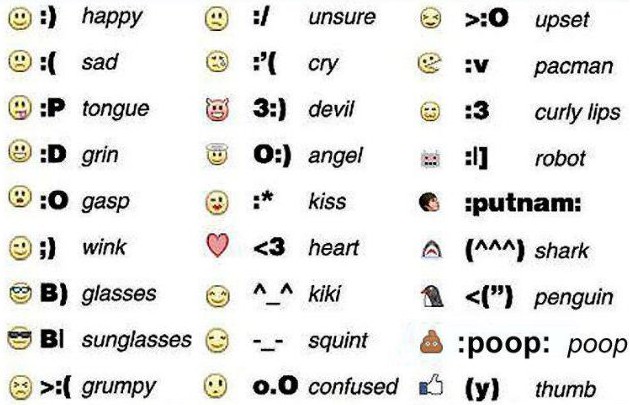
Believe it or not, emoticons (or Smileys) have been in use since the
19th century to punctuate written words with graphics simulated by
characters. An historical newspaper specialist found what appears to be a sideways winking smiley face embedded in The New York Times copy of an Abraham Lincoln speech written in 1862 "(applause and laughter ;)";. There is some debate as to whether it is a typo, a legitimate punctuation construct, or an emoticon.
Facebook gives you options to adding your mood (or activity) – to your
own posts – or to comments you write on your friend’s content. Below are keystrokes you can use to form emoji, and further on I show you how to use Facebook's new mood and activities emoticons within your own posts
When you’re commenting, or in chat, you can type in these characters to add punch to your words:
Need a little weekend reading? We’ve compiled our top ten Twitter stories of the week, which includes the late Roger Ebert’s 8 rules for using Twitter, 5 ways that social media content is evolving for brands, news that men are far more likely that women to use social media whilst on the toilet (or drunk), how small business are using social media (and what they might be doing wrong) and a look at the many hats of a community manager.
Here are our top 10 Twitter stories of the week.
1. Roger Ebert’s 8 Rules For Using Twitter
Much-loved film critic Roger Ebert died on Thursday after a long battle with thyroid cancer. Surgery in 2006 had left him unable to speak, but he continued to be a prominent user of social media, and Twitter was a particular favourite. Indeed, after some initial resistance, with Ebert proclaiming that he would “never become a Twit” and that Twitter represented “the end of civilisation”, he would go on to write more than 30,000 tweets before his death. 2. 5 Ways Social Media Content is Rapidly Evolving For Brands
Anyone working in social media marketing appreciates the unique challenges of attempting to budget and plan for the upcoming year’s social media strategy. How can we know the type and level of resources we’ll need to be successful when the mix of social content is evolving so quickly? And when most social marketers have only recently secured budgets commensurate with the amount of time and resources required to succeed in social media marketing, how do we stay ahead of emerging trends in 2013? Did we know we’d need a Pinterest budget a year ago? Probably. Do we need a Vine budget today? Probably not.
Read More on MediaBistro (Twitter image via Shutterstock.)
Friends had suggested I go to SXSW many times, but I never really saw the value. Then in mid 2012, I hear from +Kip Wetzel (whom I admire for his work in taking the reins of the @ComcastCares account in 2011). He told me he had a plan for a panel and when he was through with his convincing pitch, I knew this was a disruptive topic for the customer service industry. My book on the subject came out in 2011; this panel could be groundbreaking. It was time the philosophy of reaching the customer where they want to be reached become the norm.
Kip craftily assembled a group of folks with the backgrounds to handle the topic:
+Carla Saavedra Kochalski "Manager of Social Media & Digital Content for Samsung Mobile USA's Customer Care Team" - but in reality a very talented young woman who truly "gets' the customer and can apply balance to social media custiomer service. She's been a driving force in enterprise-level social media strategy since 2010.
+Bianca Buckridee "Social Media Operations Manager @ChaseSupport" American Banker Magazine said: "She has a thousand-watt smail that never seems to sitch off and a sunny personality that has surely servived her well on the front lines of customer service." She grasped the value of customer social media comments as early as 2009, and has been on a mission to perfect the outreach ever since.
+Brooks Thomas "Southwest Air: Emerging Media. A journalist who's defined "emerging media for his brand. He personalizes the airline's blog with words like, "I know how your morning went down. Your synchronized yawn-and-stretch routine happened as it always does. You almost tripped on a Tonka truck on your way to the bathroom. You groggily stumbled down..." Customers can related to a brand through his words.
Three incredibly intuitive and smart people. It was my job to keep the peace and help steer the conversation. I didn't have to do much steering. To a packed room of 500, we not only got our points across, but engaged the audience ... below is the Powerpoint, and a portion of the panel on video. I hope to see everyone next year and see how the #custserv philosophy has advanced.
Our panel: Bianca Buckridee (JP Morgan Chase), Brooks E Thomas (Southwest Air), Carla Saavedra (Samsung Mobile US) and I at addressed 500 social media, brands and customer service enthusiasts.
The crowd responded with a ton of Tweets including comments, quotes and links that carried actionable insights. Before I post the deck online, I thought I'd share this valuable collection
So I'm clearing out my email before I go to sleep. Decide to clean out a mailbox that's pretty much dead - left over from my old marketing agency days. To my surprise, I see an email from eBay requesting that I pay for an item I supposedly purchased on the site.
I had to shake my head, as I knew I hadn't used this email address in years. I examined the email. In the area where eBay would insert the User ID of the buyer, was a series of numbers. Hmmm, strange ID. I try to check out the headers to see if the email came from eBay. This is close to impossible to do on the phone, so I examined the links - and indeed the email did seem authentic.
Within a few hours, an invoice was sent to the same email address, addressed "Dear 2679302013" with my name appearing at the top of the email.
It's after midnight, so I took to my laptop to research further. I perform an eBay bidder search by going to eBay's advanced search:
I find that this user ID made one purchase (the one I was invoiced for), but the purchase was made while I was on my radio show. I clearly couldn't have made this purchase. The User ID also showed eBay's new user icon with 0 feedback. By clicking on a user's feedback number, you can find out when the user first signed up for eBay. Clicking through I find that they signed up for eBay on a Saturday as well. Hmmm. I usually don't sign up for new accounts when I am on the air.
I went to eBay - and clicked the Customer Service link, hoping to send them an email alerting them of the impersonation. I was amazed to find that eBay's customer service takes phone calls 24 hours a day, 7 days a week. It was after 1 am at this point, but I figured, why not give it a shot.
The customer service representative (working from eBay's Salt Lake City hub) answered the call and listened to my tale of woe. I had forgtten several things:
eBay keeps all the data user's input when you sign up for an account
IP addresses are attached to transactions
eBay sends out an email upon opening an account
"Charm", the CSR sent an email to the registered email address with a code to confirm that I was indeed the owner of the address. I read her back the code from the email and she said that eBay would remove the email address from the account. What bother's me is that the account is still for Marsha Collier, and is still an active account on the eBay site.
Lesson learned? If you have old email accounts, be sure to check them regularly. If I would have followed my own advice, I might have noticed the initial registration email that came from eBay (sent 2 days after the user registered the bogus account) welcoming me to the site. I sincerely wonder why eBay no longer requires an email address confirmation from those who open an account. If they'd have, the user would not have been able to make a fraudulent purchase - as I'd not confirmed the authenticity of the address.
I recommend in my books to let brands know when they have done something right; when you are pleased with their service. (They must get so sick of social media complaints, that a compliment usually brightens their day, and the reply with a "thank you." So next morning, I used Twitter to thank @eBay (and @AskeBay) for their CSR's excellent service. All I got back was the sound of crickets - no response.
A whopping 95% of those claiming they never use the cloud actually do so via online banking and shopping, social networking, and storing photos and music.
While “the cloud” may be the tech buzzword of the year, many Americans remain foggy about what the cloud really is and how it works. A national survey by Wakefield Research, commissioned by Citrix, showed that most respondents believe the cloud is related to weather, while some referred to pillows, drugs and toilet paper. Those in the know claim working from home in their “birthday suit” is the cloud’s greatest advantage. The good news is that even those that don’t know exactly what the cloud is recognize its economic benefits and think the cloud is a catalyst for small business growth.
Survey Highlights:
95% of those who think they’re not using the cloud, actually are
3 in 5 (59%) believe the “workplace of the future” will exist entirely in the cloud
40% believe accessing work information at home in their “birthday suit” would be an advantage
More than 1/3 agree that the cloud allows them to share information with people they’d rather not be interacting with in person
After being provided with the definition of the cloud, 68% recognized its economic benefits
14% have pretended to know what the cloud is during a job interview
The cloud is what powers today's business and social sphere online, are you using it to your best advantage?
Here are four marketing strategies you don't want you to forget. Commerce is your goal — but "social" will get your business front and center with prospective customers. Include videos and engaging content on your website, and interact on other sites and blogs.
Keep your website fresh: With all the pressure about posting in social media, keep in mind that ultimately you need to direct visitors to a core website where they can learn all about your business — and make purchases. Create a web presence that reflects your business and your company culture. Make it accessible and engaging.
Include instructionalvideos: Build a library of Facebook videos or YouTube uploads that pertain to your business and demonstrate your products. Link to these videos from your website and post them on your Facebook business page.
Friend and tag other businesses onFacebook: It's just as easy to tag friends on your Facebook personal page and fans on your business page, but you can also tag other business pages as well. See the screenshot above. Go to friendly businesses and "Like As Your Page." Be social — and help spread the word — by including other businesses in your posts.
Make social media fun: Keep the social conversation going. Post more often on a couple of sites instead of posting rarely on many. Aside from posting relevant content regularly (and not self-promoting all the time), reply to those who post to your accounts. Answer and ask. The most desirable social media personas are those who interact regularly.
Let's talk on Twitter! You'll find more tips in my book pictured below, "Social Media Commerce for Dummies"
To many people, it's not news when I come out with a new book, I write books for a living; I don't write books to get speaking engagements. What most people don't realize is that writing and researching is my passion. Readers can go on the web and get "common knowledge" anywhere. My secret sauce is the pressure I put on myself to delve deeper. There will be no mention of a hot new tool unless I personally have tried it - and have checked out the company who provides the service. Nor will I tout expensive solutions, I know small business needs to run a tight ship. Money is time - and time is money.
The reader is my customer. In over a decade of writing on e-commerce and customer service, I feel a strong responsibility about what I write. I don't want to steer anyone in the wrong direction. When you read one of my books for small business (whether the book is directed at beginners or advanced readers), know you are getting honest and well-thought out advice. My books reflect hundreds of hours into investigation into the tools, strategies and ideas in each book. I try to update my books to a new edition every 18 months, so the information is always fresh.
I especially enjoy, over the years, getting emails from my readers. I put my email address in all of my books - even back in the 90s when people thought I was nuts for doing so. Readers keep me apprised of their successes and failures.
Below is the first review of the book that appeared on Amazon (I'd like to thank "Dad of Divas" whoever he is). I hope you'll give my latest book a look. I think it might clear up some social media misconceptions for you. You will find it here.
Thank you to everyone who has read my books. If you've never read one, I think this book might be a great place to start. (Here is the press release from my publisher - I've never thought of myself as a "blockbuster)!
Wiley Announces Latest Book by Bestselling Author Marsha Collier - Social Media Commerce For Dummies®
Blockbuster author Marsha Collier empowers brand owners to capture customers, sales and revenue using social media
Social Media Commerce For Dummies
Indianapolis, IN (PRWEB) December 13, 2012
Today, the world’s bestselling reference series, For Dummies® announces Social Media Commerce For Dummies (Wiley, 978-1-118-29793-3, November 2012) to help brands and small businesses understand why social media is important to their bottom line and how to adapt their online presence to include social commerce.
The undisputed expert on eBay and a recognized authority on social media marketing, author Marsha Collier delivers another one-of-a-kind For Dummies guide that introduces readers to social media commerce and explains how to use social media to provide better customer service, generate sales online and build a customer base. Social Media Commerce For Dummies helps readers determine where the best market reach opportunities exist, which sites to integrate with, and more.
"Social media enables small business -- even professionals -- the opportunity to compete on a level playing field with big brands. After much research, I've found the strategies in this book will change the marketing game as we know it,” said Collier.
Social Media Commerce For Dummies is now available for purchase online and at retailers nationwide in both print and all e-book formats. For a full list of retailers, visit http://www.dummies.com/buy/9781118297933. Additionally, the Cheat Sheet on Dummies.com includes helpful hints for social media commerce including useful Facebook keyboard shortcuts, Marsha’s Social Media Commerce Toolkit and more. For additional information about this book and related For Dummies products, visit http://www.dummies.com.
About the Author Marsha Collier (Los Angeles, CA) is the world's bestselling author on eBay topics. Her books combine for over a million copies in print. Leading titles include eBay For Dummies, Starting an eBay Business For Dummies, and eBay Business All-in-One For Dummies. She has recently branched into social media topics, authoring Facebook & Twitter For Seniors For Dummies and The Ultimate Online Customer Service Guide. Marsha is also an in-demand speaker and trainer who appears at over 50 events per year.
About For Dummies® After 20 years, more than 250 million copies printed, and millions of e-books downloaded, For Dummies is the world’s bestselling reference series, well known for enriching people’s lives by making knowledge accessible in a fun and easy way. Loyal customers around the globe agree that For Dummies is “more than a publishing phenomenon … [it is] a sign of the times,” [The New York Times]. With more than 1,800 active topics covering everything from health to history, music to math, sports to self-help, technology to travel, For Dummies is dedicated to Making Everything Easier. The For Dummies brand presence continues to expand wherever there is a need to know, including e-books, mobile apps, e-learning courses, a corporate custom publishing program, a robust consumer website and a licensed product line that includes consumer electronics, culinary, crafts, video, software, musical instrument packs, home improvement, automotive, game and more. For more information, visit Dummies.com. For Dummies is a branded imprint of Wiley.
If you intend to promote your brand and interact with customers through social networks and social media channels – and I highly recommend that you do – you must realize your employees will be there as well, with their own personal accounts. There’s no reason not to encourage your employees to explore and engage in social media communities online, but remember, they are also the face of your company to all their friends and associates – as well as to the customers they know. What they say online or the type of photos they post on their personal accounts may reflect, albeit in a roundabout way, on your business. When they directly talk about you or your business, it will have a cause and effect relationship.
It is your job to guide your business’s online culture and protect your brand’s online persona. Provide guidelines for your employees in the form of a Social Media Policy. This written document, similar to other codes of conduct you have for employees, will let them know what type of behavior you expect from them online and any limits as to what business-related information they can share in the public stream.
Here’s how one of our nation’s biggest companies handled it. Back in 2009, before most people thought about setting guidelines, Adam Brown broke ground by developing a 4R social strategy (review, respond, record, redirect) and spearheaded the development of social media guidelines for the Coca-Cola Company. Aside from designating a code of conduct for their official online spokespeople, Coca-Cola also laid out specific principles for their associates. By taking a look at what Coca Cola deemed appropriate, perhaps it will help you forge a set of standards for your own employees. From Coca-Cola’s Online Social Media Principles, the guidelines below with my explanations outline expectations for any online activities – personal or professional – where employees reference the company or have made their association with the company known.
“Adhere to the Code of Business Conduct and other applicable policies” – Coca Cola has several policies regarding specific business activities, including general conduct, information protection and insider trading. All employees (from the CEO to interns) are expected to follow these when mentioning online that they are employees of Coca Cola.
“You are responsible for your actions” – This point is a reminder to exercise sound judgment and common sense when posting online because employees will be held responsible if their actions negatively impact the business or its image.
“Be a ‘scout’ for compliments and criticism” – This guideline acknowledges that employees are “vital assets for monitoring the social media landscape.” Coca-Cola even supplies an in-house email for forwarding both positive and negative comments employees observe online, so they can feel confident negative situations will be addressed without feeling like they must be the one to take action.
“Let the subject matter experts respond to negative posts” – This point stresses, again, that should employees encounter a potentially damaging post about the business, the post should be referred to those trained and approved as official online spokespeople to handle responding.
“Be conscious when mixing your business and personal lives” – This principle recognizes that personal and business personas often intersect online and reminds employees that everything that is posted online – even when channels or profiles are “private” or “protected” – can still ultimately be seen by anyone at any time through sharing, forwarding and general unintentional carelessness.
Can social media be used to help you make money? Yes it can. I've learned a lot while writing my upcoming book, Social Media Commerce For Dummies and I want to share with you. Submit pre-chat questions or ask them live. Let's share strategies and tactics to help your business make the most of social commerce.


 Need a little weekend reading? We’ve compiled our top ten Twitter stories of the week, which includes the late Roger Ebert’s 8 rules for using Twitter, 5 ways that social media content is evolving for brands, news that men are far more likely that women to use social media whilst on the toilet (or drunk), how small business are using social media (and what they might be doing wrong) and a look at the many hats of a community manager.


